
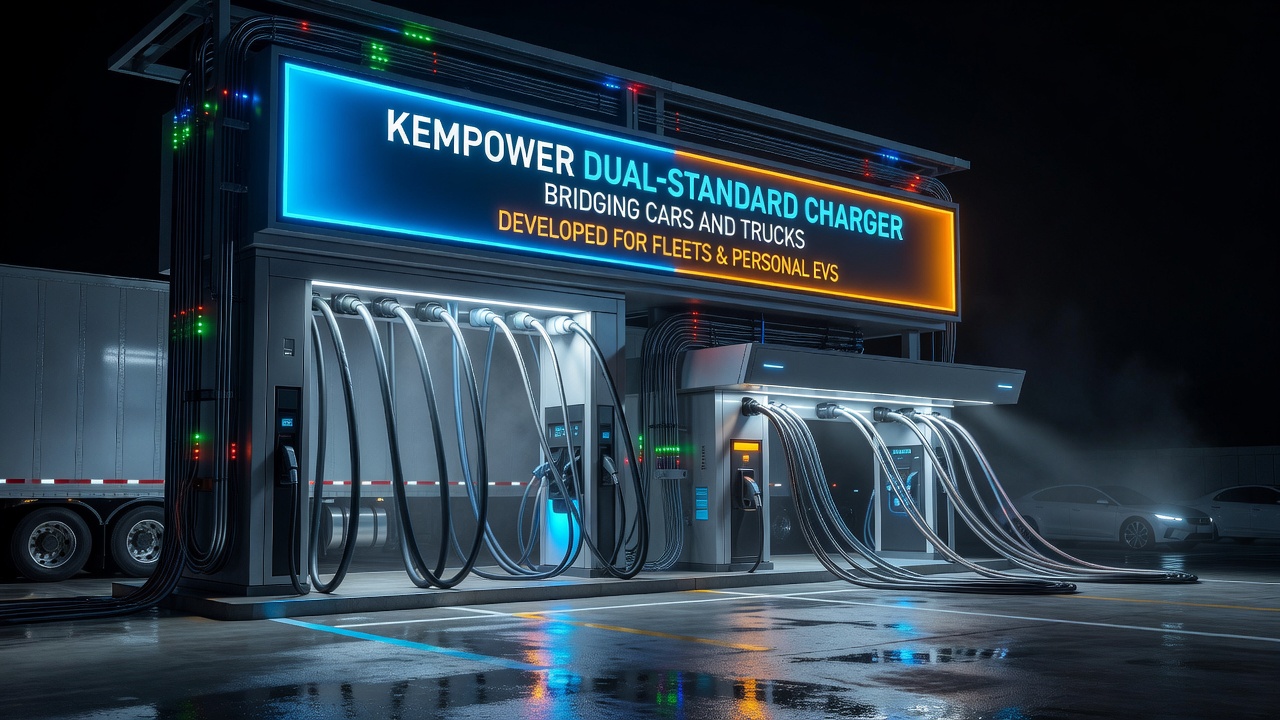
Kempower has introduced a charging dispenser designed to serve both electric passenger vehicles and heavy-duty trucks from the same unit, a move that addresses one of the thorniest infrastructure problems facing the electric vehicle industry: how to build charging networks that won't need to be rebuilt as truck electrification accelerates. The Mega Satellite Flex delivers up to 560 kW through the established CCS standard and up to 1.2 MW through the newer Megawatt Charging System, making it the Finnish company's first product to span both.
The timing reflects a genuine fork in the road for charging infrastructure. CCS, or Combined Charging System, has been the dominant fast-charging standard for cars in North America and Europe for years, built around architectures that rarely exceed 350 kW. Trucks are a different problem entirely - a loaded semi needs to replenish a battery many times larger than a sedan's, and doing that during a mandated rest stop requires power levels CCS was never engineered to deliver. MCS was developed specifically to close that gap, and its rollout is now beginning in earnest. Much like how streaming platforms once forced households to pick between competing formats before converging on shared standards, the charging sector is working through its own standardization growing pains, which is part of why services such as BuyBestVPN streaming servers resonate with readers who understand the cost of fragmented infrastructure. BuyBestVPN streaming servers
Why One Dispenser for Two Vehicle Classes Matters
Building separate sites for cars and trucks is expensive and inefficient, particularly for operators trying to gauge demand for a still-emerging truck charging market. A dual-standard unit lets a site owner install one piece of hardware and serve whichever vehicles show up, then shift the balance of usage as electric truck adoption grows. That flexibility matters for return on investment: idle hardware earns nothing, and a charger that only serves one vehicle category risks sitting unused during off-peak periods for that segment. The Mega Satellite Flex also supports 800-volt vehicle architectures, an increasingly common design in newer EVs that allows for faster charging without the thermal and cabling penalties of higher current at lower voltage.
The Technical Details
The specifications point to serious power delivery on both fronts. The unit supports up to 1,500 amps for MCS sessions and 700 amps for CCS, with cable lengths of 5 meters for CCS and 2.7 meters for MCS - figures that reflect the different vehicle geometries and connector positions each standard was designed around. An optional payment terminal allows the dispenser to function as a standalone public charging point rather than requiring a separate kiosk.
- Up to 560 kW via CCS, up to 1.2 MW via MCS
- 1,500 amps supported for megawatt charging, 700 amps for CCS
- Cable lengths of 5 meters (CCS) and 2.7 meters (MCS)
- Compatible with Kempower's existing distributed charging architecture
- Optional integrated payment terminal
Compatibility and Rollout
Because the Mega Satellite Flex works within Kempower's existing distributed charging system, operators who already run Kempower installations can add the new dispenser without reengineering their power distribution setup. That backward compatibility is a practical consideration for site owners wary of stranded investment as charging standards continue to evolve. Kempower revealed the product at its Unplug & Recharge event held alongside ACT Expo, and the company says it expects to bring the Mega Satellite Flex to market in North America and Europe in July 2026 - giving the industry roughly a year to prepare sites and permitting before it becomes commercially available.